The fall semester ended with a whimper- I was pretty exhausted and ready for a vacation, which is pretty much par for the course as either a student or teacher. I had toyed with the idea of meeting up with my sisters to visit the pyramids in Egypt, and as the political crisis unfolded during my travels, I was pretty happy it didn't come together. Instead, I decided on Turkey: my oldest brother Tom had spent a summer there when I was eight, and I always had this image of Turkey as a place of great adventure. I'm also trying to orient myself to the Middle East, so the home of the Ottomans seemed to be a good place to check out.
I started off with a few days in Istanbul visiting some of the typical tourist places. Coming from six months in Bahrain, it was really interesting to see a place where things are, well, old: it's nice to be able to walk across the street from a Byzantine church and visit a Roman cistern (featured in From Russia with Love). I had always associated I-town with the Ottoman conquest of the Byzantine empire, and had pretty much forgotten about the ancient Greeks and Romans history before that.
I headed out to Izmir (Smyrna of Diplomacy fame), about a ten hour train and ferry ride to the south. I went to visit some family friends, so I started to really see some of the differences in modern Turkey and Bahrain. After being on the losing side of WWI, Turkey underwent a period of rapid modernization and Westernization. Separation of church and state was introduced, European clothing adopted, and minorities were homogenized or expelled. Today, the head scarf for women is a hot button issue in Turkey, whereas in Bahrain it is the norm. Many Turks drink alcohol, but few Bahrainis do. It was also interesting to see a full Islamic society in operation. The guy at the hotel was Turkish, as were the waiters, taxi drivers, and most people on the street. In Bahrain, oil money means most of these service sector jobs would be done by Indian or Filipino guest workers.
Outside of Izmir, we visited the last house where the Virgin Mary lived (it was news to me that she ever left the Israel/ Palestine area), and Ephesus, an ancient Greek Ionian city. In reflecting on the current Islamic fundamentalist backlash to Western style modernization, it was interesting to see an ancient society fully accepting of homosexuality. There were even some things that are too liberal even for San Francisco: legalized and well advertised prostitution, as well as co-ed public toilets with no stalls.
I returned to Istanbul and caught up with some friends that are professional photographers. I didn't realize that Istanbul is now a major center for the arts, but I could see why. Most of the amenities of living in Europe, but a lower cost of living, better location for traveling to Asia, and a recent explosion in patronage. I have to admit, spending time with cultural creatives did make me miss San Francisco.
I finished up with a short tour of Gallipoli and Troy. I really had no idea what Gallipoli was, but the two New Zealanders on the tour with me considered it a pilgrimage. This is the WWI site where the Turks stopped an early attempt by the British to knock them out of the war. Because most of the casualties were from Australia and New Zealand, it aroused public sentiment to leave the British empire.
Troy I had wanted to see for years. While I've gotten a bit rusty since my tenth grade reading of the Cliff's Notes for the Illiad, it was still interesting. In the tradition of Indiana Jones, one of the early archaeologists just dug trenches looking for cool artifacts. While this destroyed the archaeological record, it opened up a great cross-section to visualize how the city had been built and re-built over time. Maybe I should get that documentary with Brad Pitt to round out my miseducation.
Sunday, February 6, 2011

Friday, November 19, 2010
The Oman Episode


Things have gotten busy at work, so I hardly noticed that this last week was one of the biggest holidays in the Islamic calendar, Al Eid. I saw that we got a five day weekend, so I looked into flights to Turkey or Lebanon, but it seemed pretty expensive considering two of those days would be travel. Then, last Thursday, we got an email saying classes were canceled for the other two days of the week, creating a ten day holiday- enough time to go almost anywhere in the world. But, with one day's notice, plane tickets were now extremely high. After a bit of research, I realized that Gulf Air works like a bus- you always pay the same price as long as a seat is available in that class. Since I was flexible, I booked a cheap flight to Oman, a country I never really thought twice about before. It turns out that since the Islamic calendar is linked to the lunar cycle, it's impossible to know the exact dates of some festivals until they get officially declared.
The Lonely Planet website seemed disappointed in the changes since Oman had been discovered. This was news to me, but briefly looking at the map, I realized the huge expat community in the United Arab Emirates would be able to drive directly into Oman, bringing globalization with them. I flew into the capital, Muscat, which would be an unnecessarily long drive from the border, so I ran into relatively few Westerners. Like Bahrain, however, most people on the street and working were actually Indian, who provide most of the service economy's labor in the Gulf States. I assume most of the Omani people were celebrating Eid with their family, not in tourist areas.
Lonely Planet did have another great suggestion, which was to camp there. By Bedouin tradition, you can camp anywhere that is not clearly marked as private land, including most beaches and roadsides. So I went to Carrefour (that's French for Wal-mart)and bought a tent and sleeping bag for the cost of one night in a hostel.
When I landed, I asked the rent-a-car guy where the nearest place to camp was. He had never heard of such a thing, so he asked the guys next to him, and they suggested getting a hotel. So, I just picked up the free map, saw where the mountains were and started driving. I turned onto secondary and then tertiary roads where the streetlights ended, and just set up roadside. I woke up to the sound of goats. A herder was working them towards me, so I broke camp and headed back into town. After a day of sight seeing, I tried to head out in the opposite direction, but got repeatedly turned around. It turns out that all roads do, in fact, lead to Muscat. Eventually I found my way into the mountains and set up at a very lonely campsite, only to be woken up by a very large animal roaming the field. It sounded like a bull, but I decided to sleep in the car for the rest of the night just to be safe.
On the way back into town, I turned into a small village by the sea and came upon a guy butchering a cow right on the street. There were at least ten children watching the bloody mess (American, not British sense). An hour later, I came upon people butchering goats in a park. I only found out later that Eid is traditionally celebrated by slaughtering an animal and sharing the meat with the rest of the community. Muslims, like Jews and Christians, trace their heritage back to Abraham, so Eid is actually the celebration of his willingness to sacrifice his son Isaac to God. It's celebrated by Suni, Shiite, and Sufi alike, and is thought to be the best time to make the pilgrimage to Mecca and Medina, so pretty much everything shuts down for a week or so.
I spent the last night on a public beach on the outskirts of town. It was so crowded when I arrived that I had to backpack my gear in about a kilometer. It was nice to camp near other people, and the sand was a lot softer than rocky desert, but there was something quite magical about the empty back country of Oman. I'll certainly try and go back before my time here is over.
Thursday, October 28, 2010
Taking Care of Business


In the last two weeks, my job has gone from a means to an ends to the highlight of being here. After five schedule changes (a personal record), I now only teach one and a half undergraduate classes. Because of my low course load, I got assigned to observe my students teaching in the local primary school, as well as developing a professional development class on Globalization and the Classroom.
Getting off campus has been great. The university is very comfortable for me, since it's officially bilingual English- Arabic. This helps since my department has faculty from Turkey, Eritrea, Singapore, Egypt, Bahrain, and your lonely American. The elementary school is in a town fifteen minutes away, but is a completely Arabic environment, although they begin to take English classes in fourth grade.
The schools are strictly separated by sex, so they needed a male professor to supervise in the boys school. I've been very impressed by my student teachers- much better than my first year at Mission High! They can all do classic lecture- worksheet style classes very well, but it's harder to do group work or introduce technology, because the students aren't as familiar with it. In any case, there are far fewer discipline issues, and the elementary students seem to be interested in math at a level I have never seen in the US.
I'd like to claim I got to teach about globalization because of my experience with Thinking Beyond Borders. Actually, I needed to teach two more classes to be full time, and my supervisor said that this class was the only one with two unclaimed sections. The students are all full time teachers taking extra courses at the Ministry of Education to become master teachers. They could potentially be a tough audience, but so far they seem very interested and pretty energetic considering the time slot. The major issue is that I need to teach in English and their professional life is almost completely in Arabic. Sometimes the English teachers translate, and I try to use a lot of visuals and activities, but it's not always smooth. The other issue is that they teach all different grades and subjects, so my class is not always applicable to their job.
All in all, I'm pretty happy with the level of responsibility and discretion I've been given. There are, of course, the usual weird things, like we need to use Power point in all classes, but mostly they trust my opinion. I suppose the years of adjunct work at three or four jobs was a good preparation. I'm physically in three locations for the next six weeks, spending a lot of time in my rental car listening to the BBC, but getting lost on the backstreets less and less frequently.
Monday, October 11, 2010
First impressions of Bahrain: Hot and Muggy

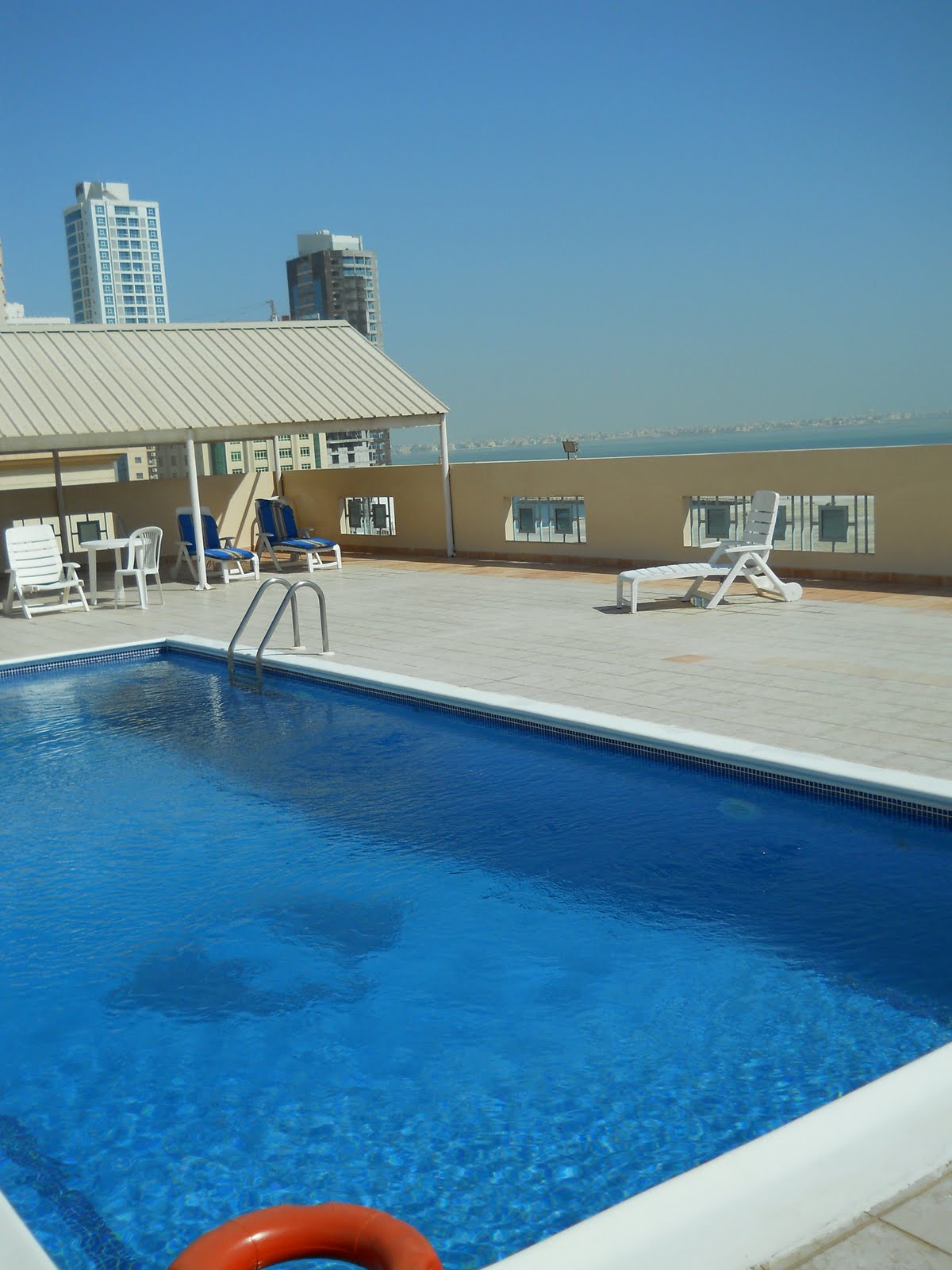
My first impressions of Bahrain were a little foggy. This was in part due to the 32 hour journey from San Francisco, but perhaps more because my glasses fogged up immediately upon leaving the airport. As they say back in DC, it's not the heat, it's the humiture.
My second impression of life here was that there seemed to be no actual Bahrainis. I was put up in a hotel for the first week while I confirmed my apartment. It was staffed almost exclusively by Filipinos and Indians. Everywhere I went, stores, cafes, and restaurants all seemed to be staffed by Filipinos and Indians. There are a lot of Americans near the Naval base, and almost every nationality in the diplomatic area, but very few Bahrainis.
Part of this had to do with arriving during Ramadan, the holy month of fasting. Since eating and drinking is allowed at night, many Bahranis stay up all night and sleep most of the day during Ramadan. Almost every place has shorten hours, and no restaurant or cafe is open during the day, as I found out the hard way. It's also forbidden to wear shorts and smoke in public during Ramadan-I'm still not sure why. I was surprised when my Human Resources person couldn't tell me the end of Ramadan. Because it's linked to the lunar calendar, they all wait for an official announcement over the TV that leads to four days of feasting to make up for lost time. A bit like snow days, I suppose.
I later heard that somewhere between a third and a half of all the people in the country are expats, and most of the Bahrainis stay out of the port area. This goes back to the early twentieth century, before the oil era, when Bahrain was a major pearl exporter. It became a critical link between British India and the rest of the Middle East, particularly Persia. As part of what was euphemistically called the informal empire, Bahrain's port of Manama became flooded with foreigners, and English was the easiest means of communication between communities. To this day, I use English with almost everyone I deal with, including the gas station attendent and janitors. While this makes life a lot easier day to day, it has frustrated my attempts to learn Arabic. The only Bahrainis I actually know are my students, who are always excited by any attempt on my part to speak Arabic. They don't think much of the Syrian speaker I imitate from Pimsleur, though.
The port area where I live has a certain Las Vegas feel about it: There are a lot of super modern tall box buildings, surrounded by empty desert areas. I ended up near the Navy base, so there are also a lot of American chain restaurants, including some I had forgotten about, such as Bennigan's, Benihana's, and TGIFriday's (weekend starts on Thursday here, though). And don't worry Dad, I spotted an Applebee's the other day, too. Despite eating good in my neighborhood, I have already lost about ten pounds. Probably water weight...
Monday, August 30, 2010
Bahrain: the next phase


After finishing my round the world trip with Thinking Beyond Borders, I took a few months off to relax in San Francisco. I accepted a job working in a teacher's college in Bahrain, an island kingdom in the Persian Gulf. I've never been to the Middle East, don't speak Arabic, and only have a vague idea about Islam, so it seemed like a great second adventure. I have a two year contract and expect to visit the US again next summer between academic years (also to avoid the 120 degree summer days in Bahrain). I will fly to Bahrain tomorrow afternoon.
My preparations this time around have been relatively light. I had to take a physical, but no vaccines this time. There was a small amount of paperwork for my visa and job, but nothing compared to eight countries worth last year. I've been listening to a number of CDs from the library: a history of the Middle East, a history of Islam, and Pimsleur Arabic lessons, which I am downloading as I type. I'm a big believer in Pimsleur's method, no writing and all conversation, which is what I want when I travel. However, I am getting some interference from studying Chinese last year, since it's the same phrases.
I also had my second annual good bye to SF party, combined with my 39th birthday this time. It was nice to see everyone one last time, but suspect they may attend next year if the timing works out! Through the magic of the Internet, I'm already looking at apartments, and have it down to four potentials. They all have gyms, pool, and maid service included. I may be able to get used to this lifestyle, after living with roommates most of my life.
My friend Loic told me he had heard of recent Suni and Shiite unrest in Bahrain. The king and most high government officials are Suni, while the majority of citizens are Shiites. This means that the government has close relations to Saudi Arabia (it's even connected by a fifteen mile causeway). However, many citizens have relatives and friends in Iran. While Bahrain is considered politically and socially moderate, there has
been a recent crack down on freedom of speech and political dissent. The US Navy's fifth fleet is based there, due to close political alliance with the United States. I am unsure how the average Bahraini feels about Americans.
Tuesday, March 23, 2010
The Ostrich Capital of the World


This was a three-day weekend to celebrate Freedom Day-the anniversary of Nelson Mendela’s release. I decided to head out to Oudtshoorn, about four hours away into the desert interior, which you may now by it’s other name: The Ostrich Capital of the World. When I arrived, the guy at the hostel convinced me to rent a mountain bike and do a 54 kilometer tour. The next morning I started at a high mountain pass, then dropped down multiple dirt road switchbacks for about 10 km.
I stopped in at the Cango Caves, which claim the largest stalagmite formations in the world. The tour was pretty challenging physically, often involving climbing up and down tight passages. The crawling was a little worrisome, mostly because my sunglasses and camera were in still in my pockets. Why I would bring sunglasses into a cave is any one’s guess.
Then the highlight: the ostrich farm. Inspired by avatar, I got the chance to ride the big bird. To mount, they blindfold it in a pen, so it won’t bite. Then you get on top, grabbing it by the wings. The ostrich has a hump for storing water, like a camel, so it’s comfortable enough to sit on. Then they open the pen, and it’s a bit like rodeo. I’d estimate I lasted eight seconds- not bad. The key is to not get kicked while
Putting the Z in ZA


I'm not sure why, but South Africans abbreviate their country ZA. I suspect Slovenia was quicker on the draw...
When we landed in South Africa from India, we ran into a bit of culture shock, The highway was smooth with little noise or dust and traffic staying on its side of the road. The group went to Rocky Road, a rural backpacker hostel, for our country orientation. After a few days of seminars, we visited the local townships where the students would work. The service project here is to follow hospice workers in the townships. Many of the patients are HIV positive, but with the new class of highly active anti-retrovirals treatments (HAART) it can be difficult to tell.
South Africa has the highest incidence of AIDS in the world, although India will probably pass it in gross numbers soon. There are a number of causes: extreme poverty, poor women’s rights, the legacy of Apartheid leading to slow public policy initiatives, and the strength of the economy regionally, which encourages a large number of men to migrate. One of the more powerful images of the epidemic for me was seeing a century old church graveyard doubled in size and nearly filled over the last ten years.
For the remainder of our time, we’re staying in Plett, a white beach town on the Indian Ocean that feels a lot like southern California. However, the students go everyday into the townships only a few miles away. There the living conditions range from lower working class to impoverished, sometimes euphemistically called informal housing. Most students seem to emotionally bond with the care worker they shadow. While they might complain about the slow pace of the work, they all seem to recognize how these women are able to make an important difference in someone’s life, often with very few resources of their own.
Subscribe to:
Posts (Atom)